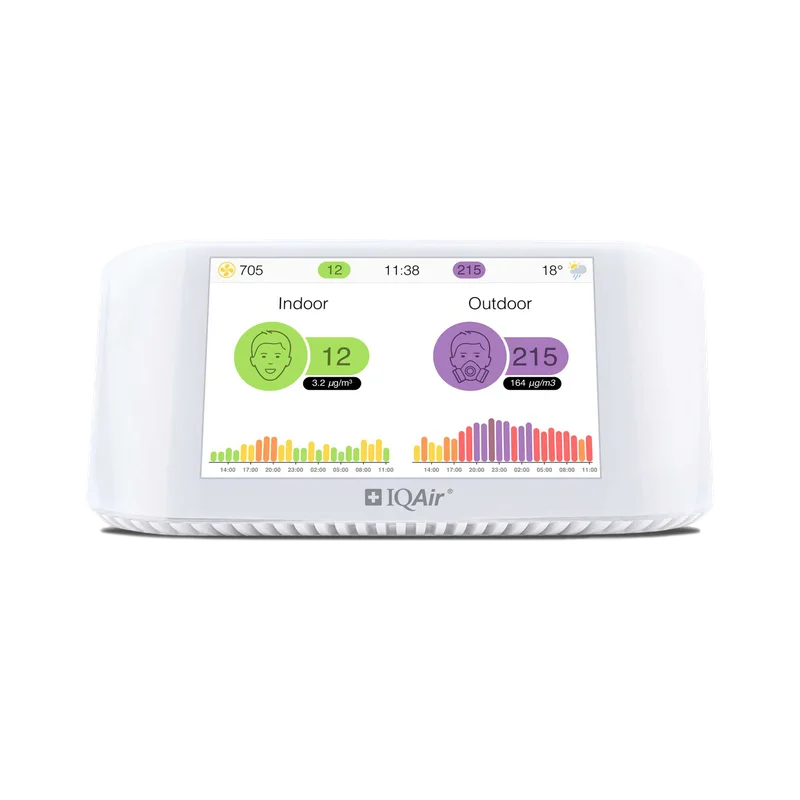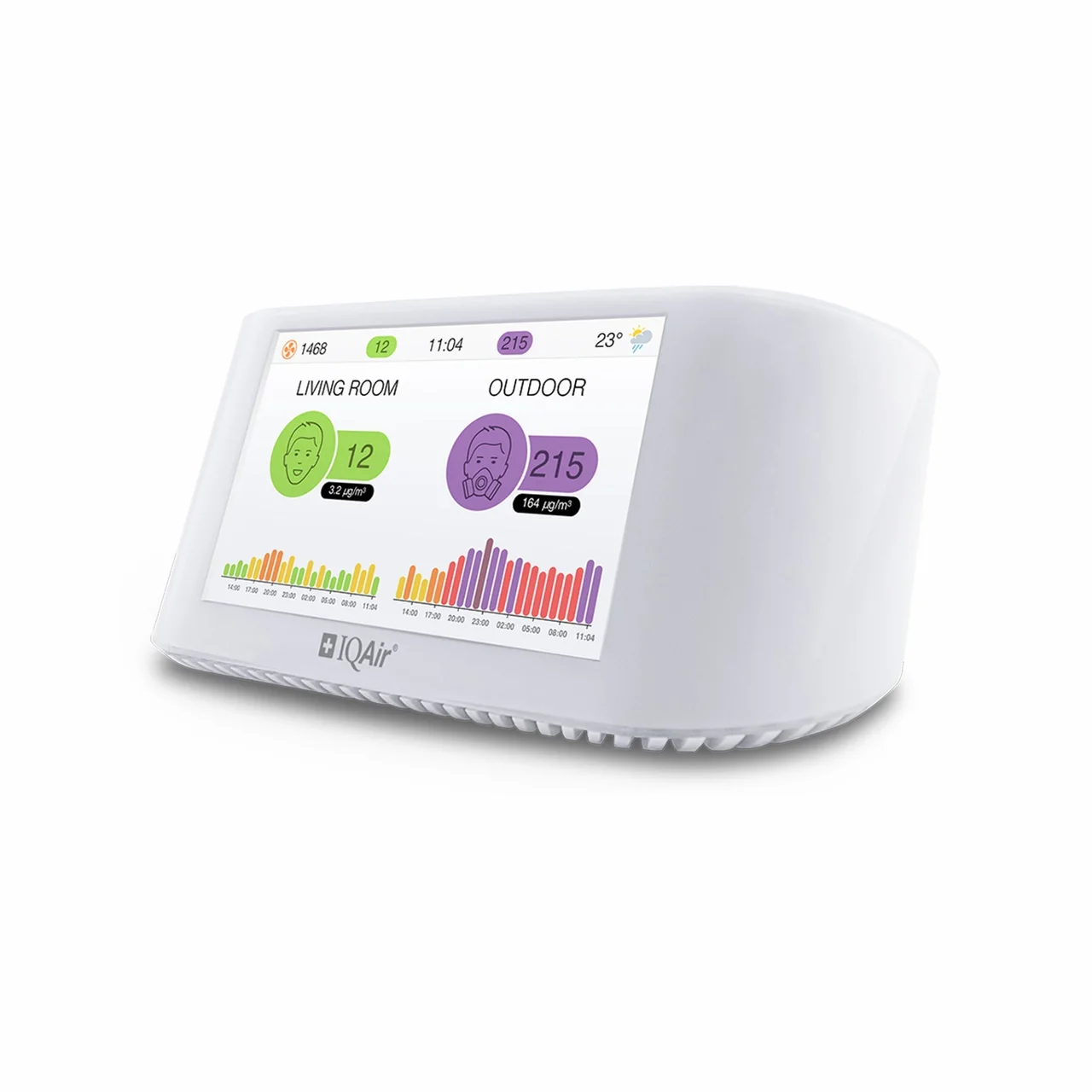
During wildfire season, the question on every affected household’s mind is not “how does the air feel” but “is it safe to open the window?” The IQAir AirVisual Pro was designed around answering exactly that question with dependable particle data. Its laser particle counter is the centerpiece: PM2.5 and PM10 readings backed by the same measurement philosophy IQAir uses in professional-grade devices.
The short verdict: the AirVisual Pro is our pick for particle-focused households, based on published specifications — a laser-based sensor, a large color display, and integrated five-year air quality forecasts. If fine particles are your main concern, it leads the category; if you also want VOCs or radon, those sensors are simply not in this device.
The problem it solves
Fine particles (PM2.5) are the indoor pollutant with the clearest, most immediate signals — smoke events, cooking, and dust spikes are all visible in particle counts. But cheap particle sensors drift, and readings that bounce around teach you nothing. The AirVisual Pro’s laser counter is designed for consistency, and its large display makes the current AQI impossible to ignore: green, yellow, orange, and red states at a glance from across the room.
The forecast integration is the feature most monitors lack. The AirVisual app blends indoor readings with outdoor AQI forecasts, so before you open windows for the evening, you can see whether outdoor air is actually better than indoor air right now. During a smoke event that guidance is worth more than any single number.
How it fits into a real home
The AirVisual Pro works best in the room where decisions happen — a living room where windows get opened, a bedroom where someone sleeps with asthma, or a kitchen-adjacent area where cooking smoke is a daily factor. The display is bright enough to read from across the room but can be dimmed for bedrooms. The device connects to Wi-Fi and feeds the AirVisual community network, which also powers the outdoor AQI maps in the app.
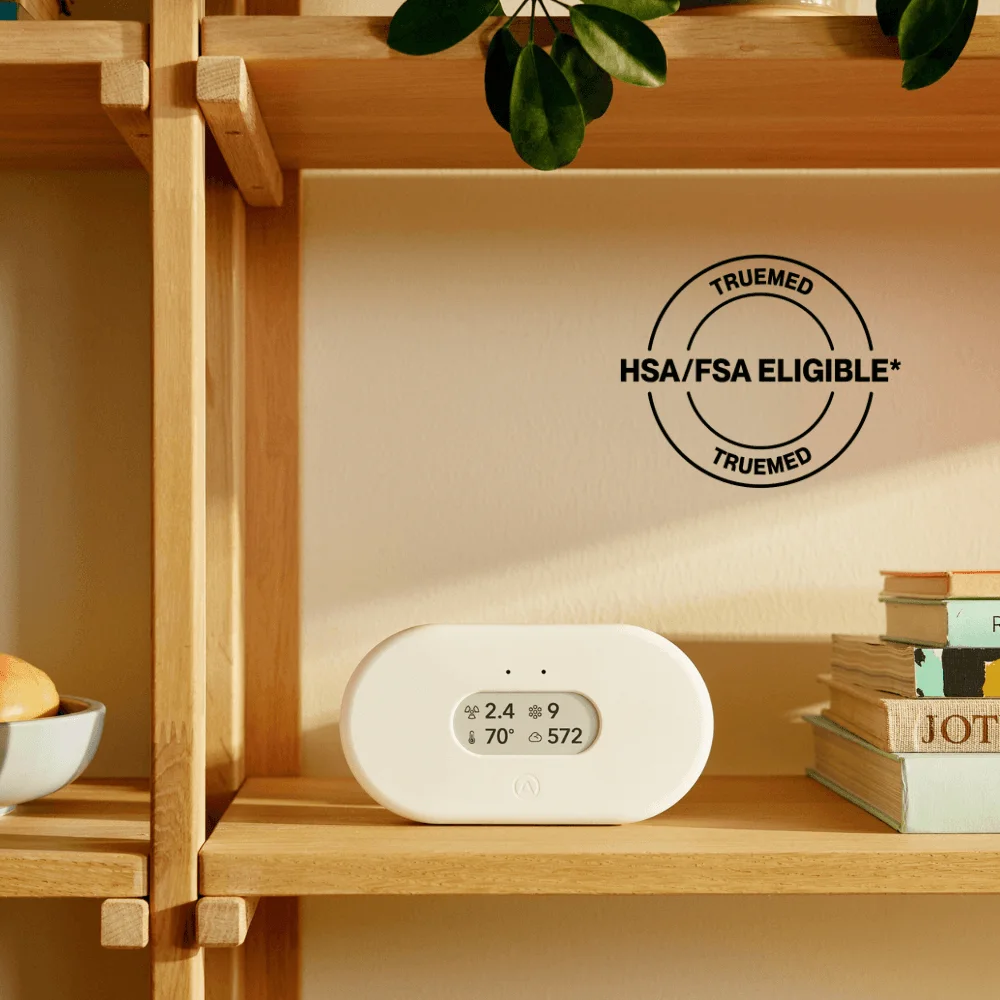
Because it is mains-powered, placement is tied to an outlet, though the unit is compact and looks at home on a shelf or side table. For households in smoke-prone regions, the combination of dependable readings and forecast-aware guidance makes it the monitor we reach for first.
Who should skip it
If your concerns are stuffy rooms and CO2, or chemical off-gassing from new furniture, the AirVisual Pro’s particle focus leaves those questions unanswered — it has no VOC or CO2-heavy feature set beyond basic CO2, temperature, and humidity. If radon is on your list, you need a radon-capable device. And if you are on a tight budget, the premium price is hard to justify when particles are a minor concern in your area.
Alternatives
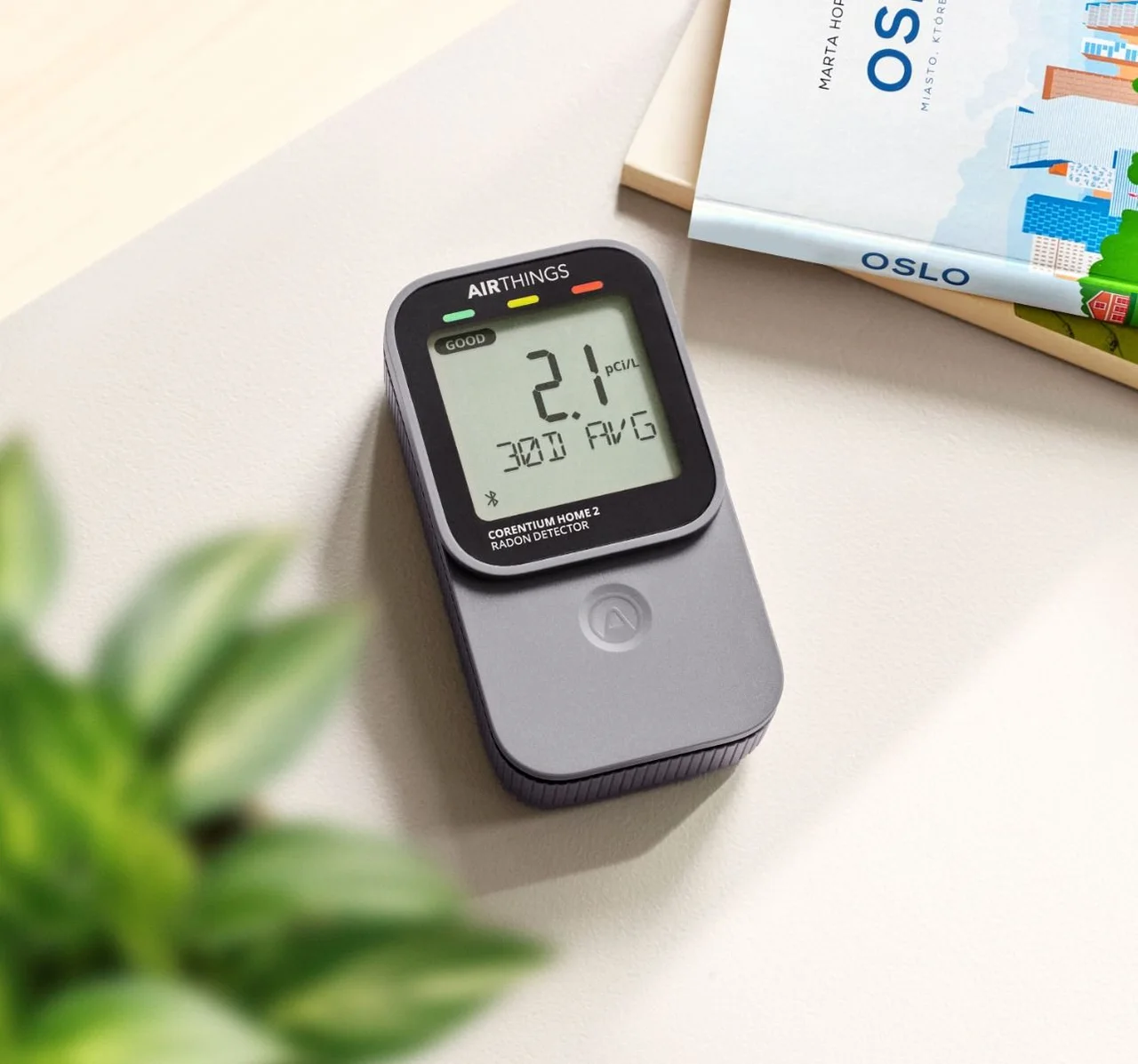
For a budget particle monitor, the Temtop M2000 covers PM2.5 and PM10 affordably. For multi-pollutant coverage including radon, the Airthings View Plus is the all-rounder pick. Our PM2.5 monitor guide compares these side by side for allergy and wildfire season.
Buying advice
Buy the AirVisual Pro when particles are a genuine seasonal concern in your region, not as a general-purpose gadget. Its value compounds during smoke events and allergy seasons, when accurate, forecast-aware data changes daily decisions. Prices are stable, so there is little reason to wait for a deep sale; the main decision is which regional version to order if plug types vary. Keep the current price comparison in mind — this model occasionally appears in bundles with IQAir air purifiers, which can be a better deal if you need both.
Frequently asked questions
How does the laser sensor differ from cheaper ones?
The AirVisual Pro uses a laser particle counter, which is generally considered more consistent than basic light-scattering designs used in budget monitors. That shows up in steadier PM2.5 readings and fewer wild swings.
Does it measure VOCs or radon?
No. The device measures PM2.5, PM10, CO2, temperature, and humidity. Volatile organic compounds and radon are not in its sensor set, so plan for a separate device if those matter to you.
What do the color-coded levels mean?
The display uses an AQI color scale consistent with the AirVisual app's outdoor guidance. Green indicates good conditions, while orange and red indicate worsening air. For thresholds relevant to your household, consult guidance from local health authorities.
Can it work without Wi-Fi?
Yes, the display shows live readings standalone, but the forecasts, history, and community features need Wi-Fi. Setup is a straightforward app-guided process on a 2.4 GHz network.
How do I clean or maintain it?
Keep the air intake and exhaust unobstructed and wipe the exterior periodically. There are no user-replaceable filters in the monitor itself; sensor drift over years is a normal characteristic of consumer monitors, so treat readings as trend indicators.